
The spotted nutcracker, closely associated with the Swiss stone pine (Pinus cembra), plays a crucial role in spreading this tree species across the mountainous regions it inhabits. Evidence of this connection can often be seen in the remnants of split pine cones and hazelnuts scattered on tree stumps and trunks.
Throughout the summer, the nutcracker buries seeds to prepare for winter, creating noticeable excavation marks in the snow as it retrieves them months later.
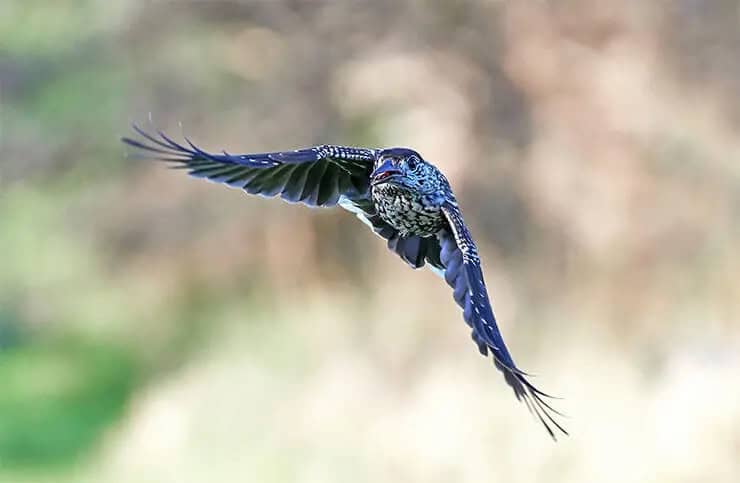
These birds make their nests within dense conifer thickets, making them difficult to spot. In certain parts of Western Europe, however, spotted nutcrackers are known to be quite approachable, with documented instances of them perching on people’s heads in England and Holland.
Fascinating Facts About the Spotted Nutcracker
Unlike many other conifer seeds, Swiss stone pine seeds are not well-suited for natural dispersal. They lack the wings that allow other seeds to drift in the wind, are heavier, and the pine cones that contain them do not open on their own.
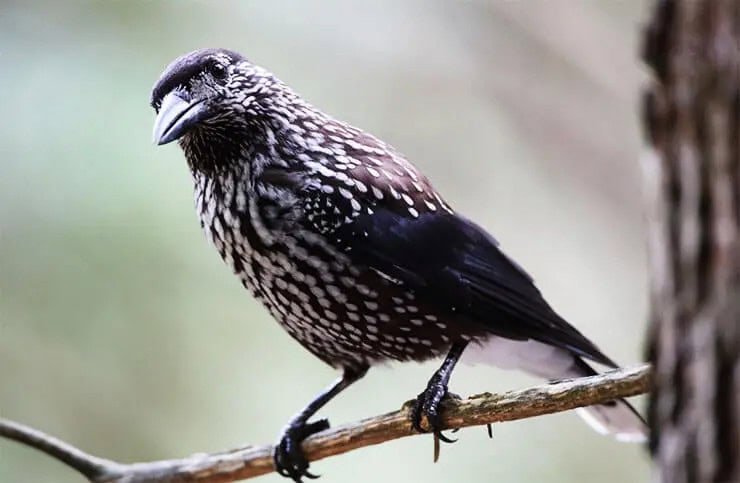
This is where the spotted nutcracker (Nucifraga caryocatactes) steps in, prying open pine cones to access and consume the seeds. The seeds serve as its primary food source and are crucial for feeding its young as well.
By stashing away seeds, the nutcracker inadvertently aids the Swiss stone pine’s spread to higher altitudes and distant areas.
Nutcracker’s Impressive Memory
Spotted nutcrackers are known for their impressive memory. Each year, they hide between 3,000 to 5,000 seeds, and their remarkable recall allows them to retrieve most of these even under snow. They use familiar landmarks, such as a specific tree or fallen log, to help them locate buried seeds.

Species Profile:
- Scientific name: Nucifraga caryocatactes
- Weight: 160 – 250 g
- Length: 32 – 33 cm
- Wingspan: 49 – 53 cm
- Lifespan: Up to 16 years
- Diet: Primarily hazelnuts and seeds of the Swiss stone pine
- Habitat: Coniferous forests
- Conservation: Threatened by habitat disturbances and forest management practices during nesting
Physical Characteristics
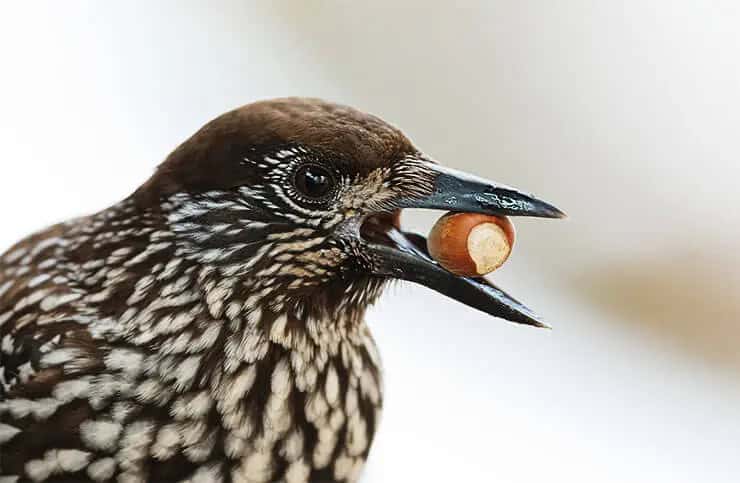
Spotted nutcrackers have a compact build, featuring a large, black, dagger-like beak, short tail, and broad, rounded wings.
Their dark brown body is finely speckled with white, with black wings and a contrasting tail that is black with a white tip. They bear some resemblance to the jay but have a more slender head.
Distribution and Habitat
The species is commonly found in montane and subalpine forests, favoring areas dense with pine and larch. During winter, they may also venture into areas with coppice woods. Their nests are typically built high up on steep slopes with isolated trees, usually around 1,700 meters above sea level.
In Italy, they prefer the Alps, nesting within thick conifer trees. The seeds of Swiss stone pines are essential to their diet, although, in some regions without these pines, they also rely on chestnut and silver fir seeds.
Dietary Habits
The spotted nutcracker’s diet mainly consists of the large seeds found in cold-climate pine cones, especially those from the Swiss stone pine. If seeds are particularly tough to crack, they will hold them between their feet and use their beak like a chisel.
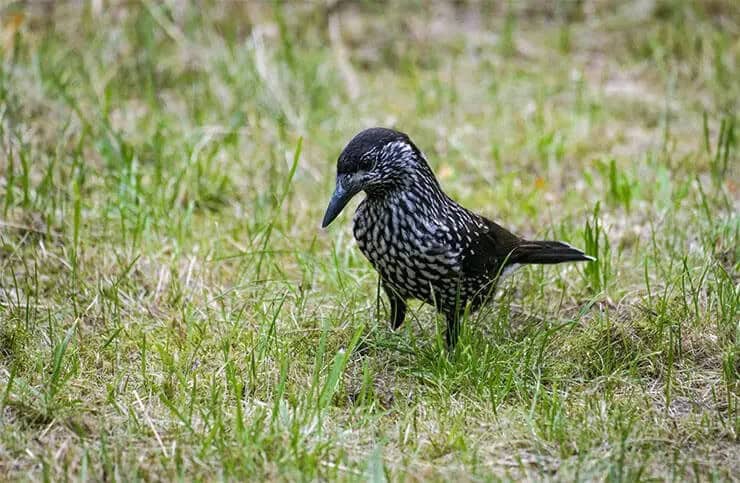
Leftover seeds are stored for future use, which helps facilitate the growth of new trees. Occasionally, they consume insects, bird eggs, and larvae, even digging into wasps or bee nests for food.
Breeding Patterns
Spotted nutcrackers build their nests high within conifer trees, often on sunlit sides. They lay 2–4 eggs, which are incubated for around 18 days. Both parents care for the young, who stay with them for several months to learn essential survival skills, including storing food.
Conservation Status
The spotted nutcracker population in Europe is considered stable, with an estimated 400,000 to 860,000 pairs, primarily in Russia, Romania, Bulgaria, and the Alpine regions. While habitat disturbances like logging during nesting can impact them, the species is currently not at risk.
However, there is limited data on their population density and reproductive success, with Swiss stone pine forests identified as ideal reference environments for further research.
Read More Birds