
The black swan, a unique and stunning bird, has fascinated humans for centuries. Its striking appearance and symbolic presence have left a mark on history and culture alike. Here’s a closer look at what makes the black swan, or Cygnus atratus, so captivating.
1. Origin and Habitat
Native to Australia, black swans also inhabit New Zealand and Japan, where they were introduced. These waterbirds thrive in rivers, lakes, ponds, estuaries, and swamps. Before European explorers encountered them in the 1600s, it was widely believed that all swans were white.
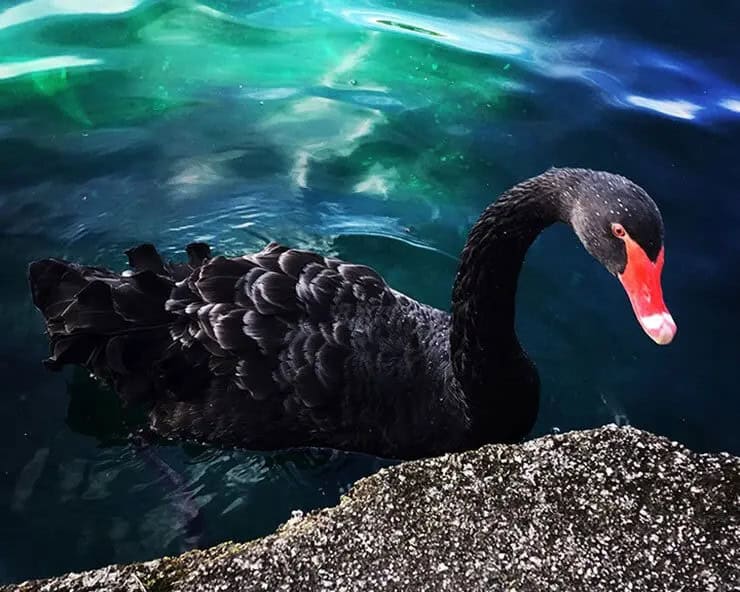
2. Appearance and Physical Traits
As their name suggests, black swans have primarily black feathers with white wingtips, a deep red bill, and pink or red eyes. Known for their long necks, black swans are graceful in water. Juveniles are usually grayish-brown before they mature, and adult males are often slightly larger than females.
3. Diet
Black swans primarily feed on aquatic plants, such as algae and submerged weeds, though they occasionally consume insects when foraging on land. Their preferred feeding time is early morning, making them well-suited to the resources in their watery habitats.

4. Reproduction and Family Life
Black swans are mostly monogamous, with pairs often bonding for life. The breeding season spans from February to September. Females build floating nests from sticks and leaves, where they lay around five to six eggs.
Both parents share incubation duties, and chicks hatch after about 35 to 48 days. Young swans learn to fly at six months but may stay with their family for up to nine months. The average lifespan of a black swan is 40 years, and adults undergo molting each year following the breeding season.
Did You Know? A male swan is called a cob, a female a pen, and a young swan a cygnet.
5. Cultural Significance
The black swan has often been a symbol of rarity and surprise. In 1843, philosopher John Stuart Mill used black swans to illustrate how false assumptions can arise from limited observations. Bertrand Russell and Karl Popper also referenced black swans to show the need for questioning scientific assumptions.

More recently, the term “black swan event” was popularized by Nassim Taleb in his 2007 book, where he explored how rare, unpredictable events can shape history.
In pop culture, the black swan gained renewed attention with the 2010 film Black Swan, which used the bird as a symbol of opposing forces and internal conflict in its characters.
6. Behavior and Movement
Though usually sedentary, black swans migrate when food becomes scarce. In flight, they travel in flocks, forming lines or V-shapes and making a distinctive whistling sound. Known for their elegance in both the air and water, black swans swim with one leg tucked above their tail, though they are somewhat awkward on land.
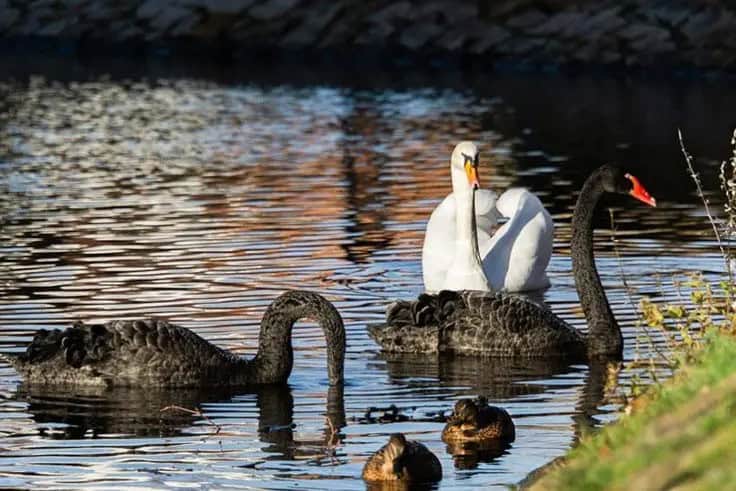
Fun Fact: A group of black swans flying is called a “wedge” due to their formation, while on land, they are known as a “bank.”
7. Predators and Population Control
While black swan populations are stable and not considered at risk, their eggs and young are vulnerable to predators such as ravens, eagles, and rats. In areas where their numbers grow too large, black swans can impact local agriculture, prompting some regions to allow limited hunting to manage populations.
Interesting Note: The black swan holds a special place in Australia, where it’s the official bird of Western Australia and appears on the state’s flag and coat of arms.
Through its beauty, resilience, and rich symbolism, the black swan continues to be a source of inspiration and wonder in both the natural world and human culture.
Read More Birds