
The idea that every animal’s life matters is partly an ethical position, but it also begins with a scientific question: which animals can have experiences that matter to them? Researchers use the term sentience for the capacity to experience feelings such as pain, pleasure, fear or comfort. Evidence is not equally strong for every species, yet it is substantial enough across many groups to shape modern animal-welfare law and policy.
This does not mean scientists can read an animal’s thoughts or prove that every species experiences the world exactly as humans do. It means behavior, nervous-system function and responses to injury or relief can be evaluated together. The result is a more careful principle: uncertainty should not automatically be treated as permission to ignore suffering.
Sentience is broader than human-like intelligence
An animal does not need language, advanced mathematics or a human-style sense of self to experience pain. The U.S. National Academies has long recognized strong evidence that mammals experience pain, while modern welfare frameworks also consider fear, distress, comfort and opportunities for positive experiences.

That distinction matters on farms, in homes and in laboratories. Cows, pigs and chickens show learning, social behavior and responses to both threatening and rewarding situations. Recognizing those capacities does not by itself settle every debate about food or animal use. It does, however, challenge systems that treat living animals only as units of production and places a duty on people to prevent avoidable pain, chronic fear and severe confinement.
The evidence also reaches beneath the surface
Aquatic animals are often overlooked because their bodies and environments are unfamiliar to us. But the World Organisation for Animal Health includes aquatic animals within its international animal-welfare work. Fish sentience remains an active area of research and debate, but evidence about nociception, learning and behavior has made blanket dismissal increasingly difficult.
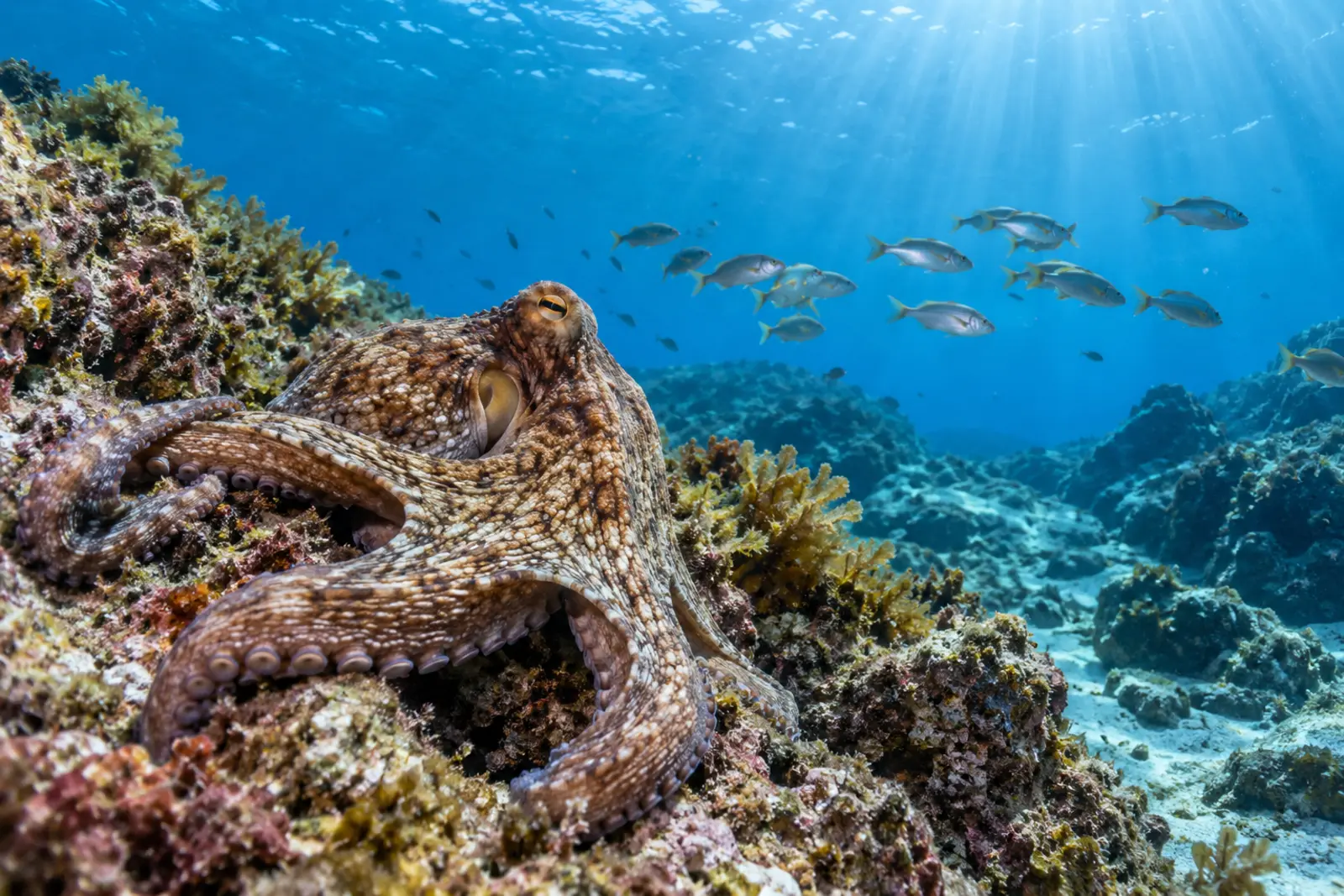
Cephalopods and decapod crustaceans have received particular attention. A review commissioned by the London School of Economics examined more than 300 studies and found substantial evidence of sentience in animals including octopuses, crabs and lobsters. The United Kingdom later included cephalopod molluscs and decapod crustaceans in the legal definition of animals covered by its Animal Welfare (Sentience) Act 2022.
What recognition changes—and what it does not
Legal recognition of sentience does not automatically ban farming, fishing, hunting or keeping companion animals. It changes the questions decision-makers are expected to ask: Can suffering be reduced? Is a harmful practice necessary? Are housing, handling and transport compatible with the animal’s physical and behavioral needs? Are positive experiences possible, rather than mere survival?
There is also a difference between a verifiable scientific finding and a philosophical claim about rights. Science can inform us about an animal’s capacity to suffer or enjoy aspects of life. Whether that capacity creates a right not to be used or killed is an ethical and political judgment. People can disagree about that conclusion while still accepting a practical baseline: unnecessary suffering should not be dismissed simply because an animal looks, communicates or lives differently from us.
The quote in the source image is widely circulated online with an attribution to Anthony D. Williams, but an authoritative primary publication for that wording could not be independently confirmed. The underlying message is better evaluated on its merits: animals are not interchangeable objects, and decisions affecting them deserve evidence, restraint and compassion.
