
White tigers, renowned for their striking appearance, have an unsettling history. Unlike their wild counterparts, white tigers are not found in nature.
Instead, their lineage traces back to a single pale tiger cub taken from its mother in the 1950s.
If you prefer not to read the full story,
Skip ahead to watch the video ->
Since then, white tigers have been selectively bred to maintain their distinctive color, leading to numerous health problems.
In 2000, a white tiger named Kenny was rescued from a private breeding facility in Arkansas. The conditions at the facility were dire; Kenny was kept in unsanitary conditions and had several noticeable deformities due to extensive inbreeding. The Turpentine Creek Wildlife Refuge stepped in to assist with his rescue.

Emily McCormack, the animal curator at Turpentine Creek, noted, “The gentleman that we rescued him from said he would constantly run his face into the wall. But it was clear that that wasn’t the situation.” Kenny’s appearance was far from typical; he had a short snout and broad face, unlike the usual tiger features. Additionally, another tiger rescued from the same place had permanently crossed eyes.
Due to their genetic makeup, all white tigers have crossed optic nerves, which can lead to vision problems.
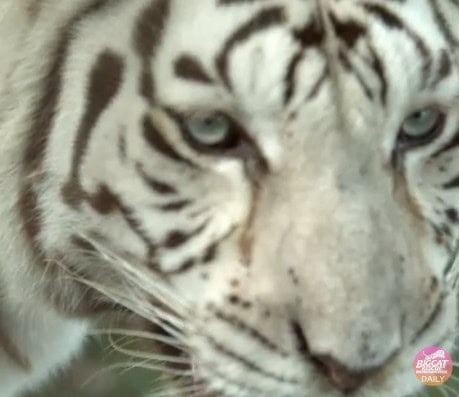
After his rescue, Kenny and another tiger were brought to the sanctuary, receiving the needed care.
Kenny enjoyed his time at the sanctuary, playing with toys and interacting with other rescued animals. Despite living only ten years, Kenny experienced a fulfilling and happy life in his final years.
To see more about white tigers, check out the video of Zabu, another white tiger, in slow motion. Share your thoughts in the comments—we’d love to hear from you!
Read more Wildlife News.


