
A potential second wild jaguar has been spotted in the United States. A photo taken on December 1st in a southern Arizona mountain range may show a new jaguar in the area, a species rarely seen in the U.S. due to habitat loss.
Preliminary analysis from the Arizona Game and Fish Department suggests this jaguar is not “El Jefe,” a well-known jaguar captured on camera last year in a nearby mountain range.
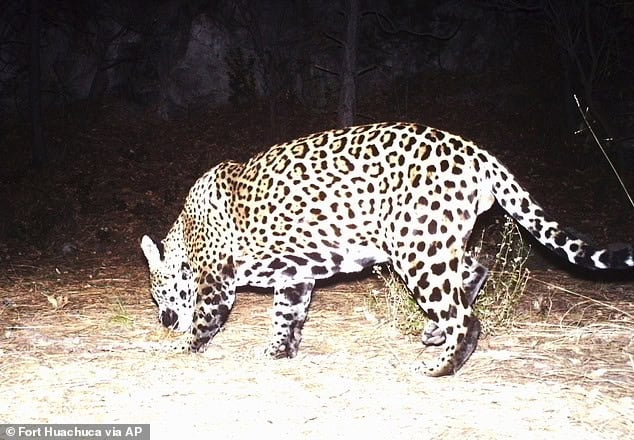
Until now, El Jefe was believed to be the only jaguar in the U.S., though he hasn’t been seen in over a year.
The new jaguar was captured on a camera belonging to Fort Huachuca, an Army base 75 miles southeast of Tucson.
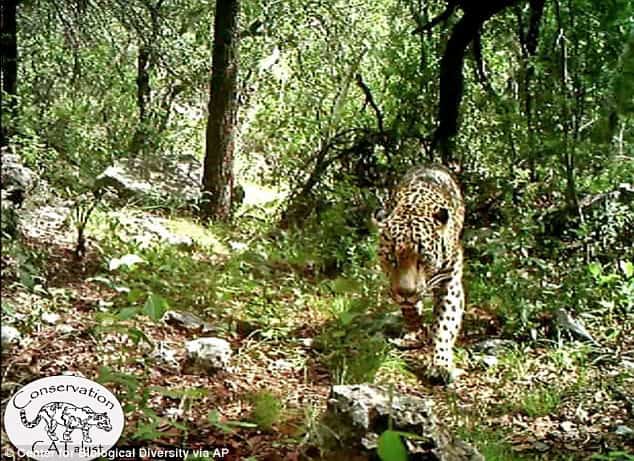
Mark Hart, an Arizona Game and Fish Department spokesperson explained that jaguars occasionally migrate from Mexico to southern Arizona every five to ten years. However, no female jaguars have been seen in the U.S. since the 1940s.
“Southern Arizona’s environment isn’t ideal for jaguars,” Hart explained. He added that habitat loss and predator control measures targeted large predators to protect livestock and nearly wiped out jaguars from the Southwest over the past 150 years. The last verified female jaguar in the U.S. was killed by a hunter in northern Arizona in 1963.
Despite this, Rob Peters, a biologist based in Tucson, sees the return of male jaguars as a positive sign.
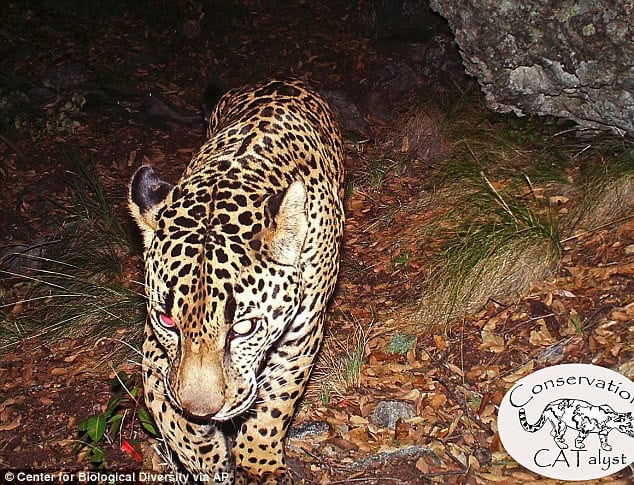
“In the last 30 years, we’ve seen five or six male jaguars return to the U.S.,” Peters said, explaining that while no female jaguars have reappeared, establishing male territories could mean females may follow.
Experts study the most recent photograph to determine if the jaguar is new to the region.
Analysts will compare the cat’s rosettes—distinctive markings on its fur—to determine if they match previous sightings.
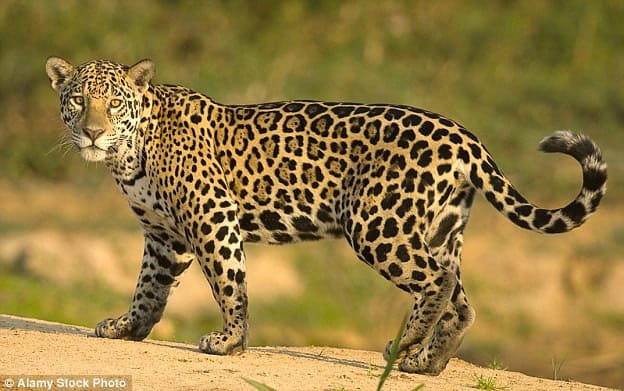
Conservationists are eager to see the outcome of a federal report outlining plans for jaguar recovery in the Southwest.
Jaguars once roamed as far north as the Grand Canyon, with female jaguars and cubs in the region. However, legal battles have complicated efforts to protect these big cats.
In 2014, the U.S. Fish and Wildlife Service designated nearly 1,200 square miles along the U.S.-Mexico border as critical habitat for jaguar conservation.
This decision sparked a lawsuit from groups like the New Mexico Farm and Livestock Bureau and the New Mexico Cattle Growers’ Association, who argued that the designation was unjustified. The legal case is still ongoing.
El Jefe has been the most well-documented jaguar in the U.S. for several years. First seen in Arizona’s Whetstone Mountains in 2011 at about three years old, he was later captured on video in 2015 in the Santa Rita Mountains near Tucson.
If the newly spotted jaguar is confirmed as different from El Jefe, it could mark an important moment for jaguar conservation efforts in the United States.
Read more Wildlife News.